
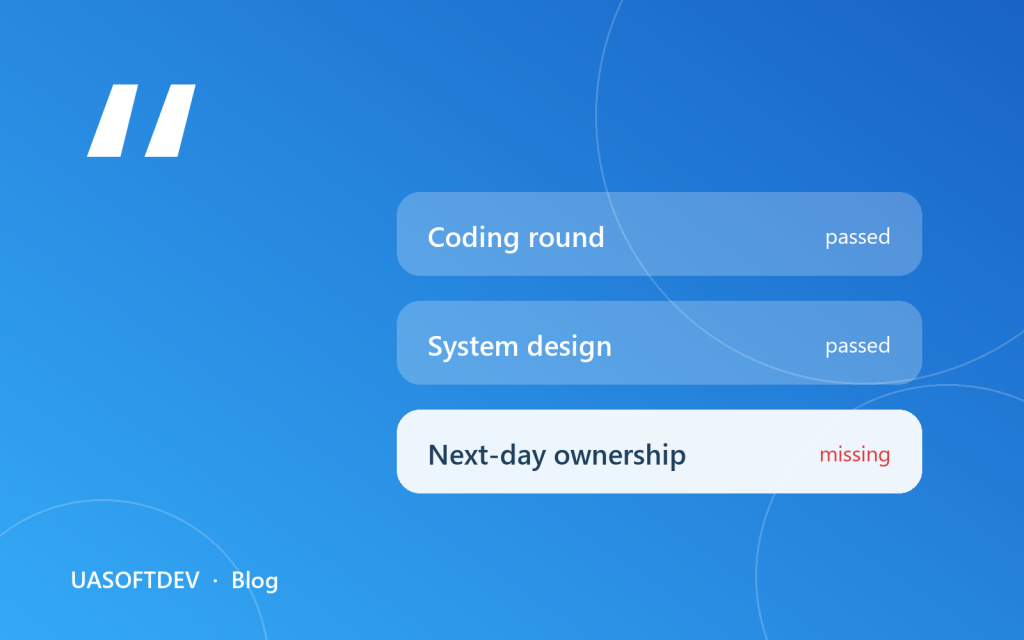
Last month a candidate aced every technical round. Clean system design, sharp answers on Python internals, two product companies on the CV. The client was ready to sign within the hour.
We said no.
Not because of skills. Because of one answer to a question that looks odd in a technical interview: “Tell me about the last time you disagreed with a product decision. What did you do the next day?”
What we actually heard
The answer was honest: “I told them it was wrong, and then I just built what they asked for.” No follow-up, no written trade-offs, no second conversation.
In a product team that is a silent failure mode. The code ships, the decision is never revisited, and three sprints later the team is rebuilding the same feature.
- Disagreement without action means the risk stays invisible.
- “I built what they asked” moves ownership back to the client.
- Nobody learns why the decision was wrong until it costs money.
Every odd question is a scar from a previous hire.
Why our interviews have odd questions
Every question outside the coding round has a story behind it. One came from an engineer who never flagged a blocker. Another came from a handover where six months of context left with one person.
We do not ask them to be clever. We ask them because each one would have saved a real engagement.
What a coding round shows — and what it misses
| Signal | Visible in a coding round | Cost if missed |
|---|---|---|
| Ownership of decisions | Rarely | Weeks of rework after silent disagreements |
| Talking to non-technical stakeholders | No | Missed requirements and extra calls |
| Handover habits | No | Context lost when the engineer rotates |
Based on our replacement cases.
Where the client's money comes in
A wrong senior hire is rarely visible in week one. It shows up in month three as rework, extra calls and a replacement search, while the roadmap waits.
That is why a two-minute “no” in the final round is cheaper for the client than a polite “yes”.
What to do on Monday
Add four questions to your next interview
They take ten minutes and show what a coding round cannot.
-
Ask about a disagreement
Not "have you ever disagreed", but "what did you do the next day". You are listening for action, not opinion.
-
Ask what they handed over
Senior engineers think about who maintains the code after them. Ask what they documented on the last project.
-
Ask about a mistake that cost money
Listen for ownership: who noticed it, who fixed it and what changed in the process afterwards.
-
Write down your own scars
List three hires that went wrong and turn each one into a single interview question.
How many interviews did it take and still no "the right one"?
Book a call - after we align on the role, we'll send 2-3 candidates pre-vetted by stack, product, and culture within ~60 hours.